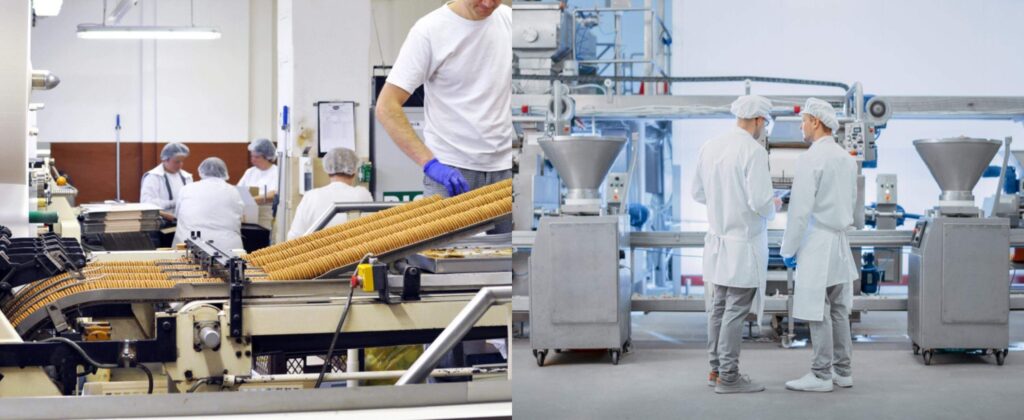
HVAC for food manufacturing is critical for maintaining food safety, product quality, and regulatory compliance by precisely controlling temperature, humidity, and air quality. In the food processing HVAC environment, these systems must support strict standards required in food-grade manufacturing facilities and heating and cooling products manufacturing in Los Angeles. Key components include high-efficiency filtration, proper air change rates (15+ ACH), and specialized ductwork designed to prevent condensation and contamination. These advanced HVAC solutions for the food & beverage industry also help manage airflow to prevent cross-contamination, promote worker comfort, and reduce energy costs through features like heat recovery systems.
Key Functions and Benefits of HVAC systems in Food Manufacturing Facilities
Food safety and quality: Maintains specific temperature and humidity levels to prevent spoilage, microbial growth, and contamination—essential in the HVAC system in the food industry to meet FDA and USDA standards.
Air quality and sanitation: Filters air to remove contaminants and pathogens, with a high Air Changes per Hour (ACH) rate (15+ recommended) to quickly remove airborne particles—critical for food manufacturing HVAC and food processing mechanical contractor projects.
Product integrity: Prevents fluctuations in temperature and humidity that affect flavor, texture, and shelf life, especially in sensitive environments such as meat processing refrigeration design in California and meat & poultry refrigeration systems in California.
Worker comfort and productivity: Creates a stable, comfortable environment for employees, which improves working conditions and productivity across HVAC food industry operations.
Energy efficiency: Incorporates features like variable-speed drives and heat recovery systems to minimize operational costs and environmental impact.
Essential design and maintenance considerations
Filtration: Uses high-efficiency filters (like HEPA) to remove contaminants. Some systems also include UV germicidal irradiation and carbon filters—important for any facility needing a contractor experienced in building food-grade manufacturing facilities.
Airflow and distribution: Designed for even air distribution to prevent cold or warm spots. Ductwork should be easy to clean—often stainless steel or washable fabric—and kept away from open product lines to maintain strict hygiene required in food processing HVAC environments.
Condensation control: Systems are engineered to prevent condensation buildup, which can cause mold and bacterial growth. Fabric ducting is a preferred option because it distributes air evenly and resists moisture absorption—important for HVAC solutions for food & beverage operations.
Pressurization: Critical process rooms are often kept under positive pressure to prevent contaminated air from entering.
Easy maintenance: Designs prioritize accessibility for cleaning and service to reduce downtime and maintain sanitation compliance.
Zoning: Uses customizable systems to create different climate zones for production, storage, freezing, and packaging areas—an essential part of modern food processing HVAC and food manufacturing HVAC design.
Why Choose Us for Food Manufacturing HVAC in Los Angeles?
-
Energy-efficient systems – We integrate high-efficiency equipment, heat recovery, and variable-speed systems to cut operating costs.
-
Reliable mechanical contracting – Full-service food processing mechanical contractor for design, installation, and maintenance.
-
Fast support & reduced downtime – Quick response for repairs and service to keep your plant operational.
Request Service